

News
Push back of responsibility: Human Rights Violations as a Welcome Treatment at Europe’s Borders
In a new report, DRC in partnership with six civil society organisations across six countries, have collected records of thousands of illegal pushbacks of migrants and refugees trying to cross Europe’s borders. Testimonies also reveal unofficial cooperation between authorities in different countries to transfer vulnerable people across borders to avoid responsibility.

Jan Grarup
During only three months, authorities illegally prevented 2,162 men, women and children from seeking protection. The instances of illegal pushbacks were recorded from January to April 2021 at different border crossings in Italy, Greece, Serbia, Bosnia-and-Herzegovina, North Macedonia, and Hungary. More than a third of the documented pushbacks involved rights violations such as denial of access to asylum procedure, physical abuse and assault, theft, extortion and destruction of property, at the hands of national border police and law enforcement officials.
It is extremely worrying to see that so many people experience pushbacks and border violence. It goes without saying that states must stop the violence and these illegal practices, and perpetrators must be held accountable.
Charlotte Slente, Secretary General of DRC
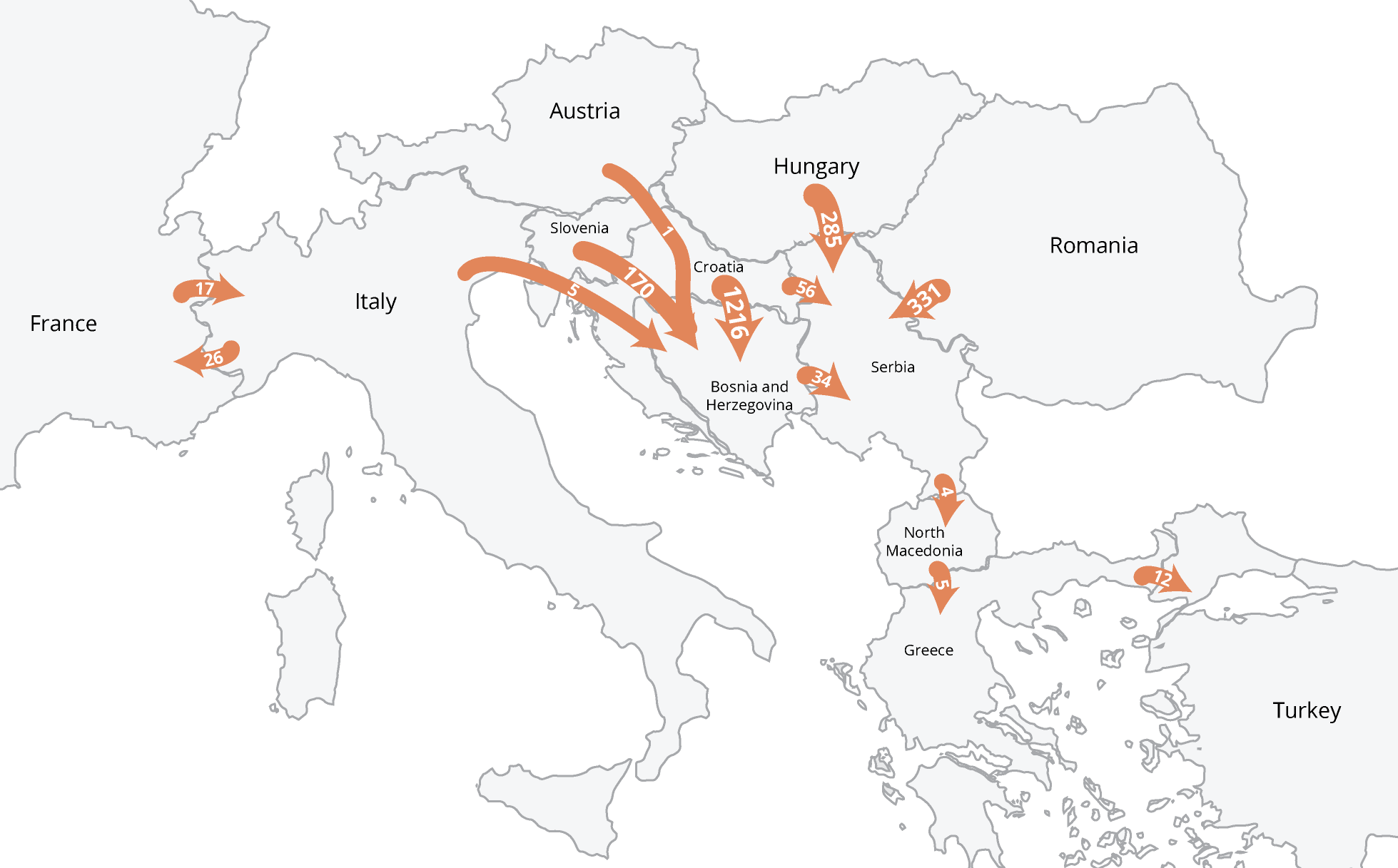
Further, the report documents 176 cases of so-called “chain-pushbacks” where refugees and migrants were forcefully sent across multiple borders via informal cooperation between states to circumvent their responsibility and push unwanted groups outside of the EU. This could be from Italy or Austria through countries like Slovenia and Croatia to a third country such as Bosnia-and- Herzegovina.
"To avoid such illegal practices to continue, DRC and its partner organisations strongly recommend that an independent border monitoring mechanism is set up to ensure that rights violations are monitored and that effective investigations into evidence submitted by civil society actors are conducted," says Charlotte Slente.
About the report
The report builds on data on the illegal prevention of people seeking protection along Europe’s border, which was systematically collected and analysed alongside the provision of legal remedies for those involved. The report is estimated to only reveal the tip of the iceberg. In many places along the monitored routes, NGOs are prevented from documenting the extent of illegal practices. Other challenges include people being fearful of repercussions on their status or being prevented from moving forward on their journey.
Resorting to pushbacks as a means of protecting states' borders is illegal. States have the obligation, under the Universal Declaration on Human Rights and the European Convention on Human Rights, to ensure that people can effectively seek asylum and to respect the principle of non-refoulement. States are further, under the same legal frameworks, prohibited from undertaking collective expulsions and required to treat each person with human dignity.
Find the report here: Push back of responsibility: Human Rights Violations as a Welcome Treatment at Europe’s Borders

PRAB Partners









More content like this
page
Protecting Rights At Borders
news
Protecting Rights at Borders (PRAB)

news
12,000 pushbacks in 2021 reflects worrying normalization of illegal practice

news
Using family separation as deterrent – new report documents alarming illegal push-back methods
news
Countering human smuggling: No silver bullet for safer mobility
news
Croatia/EU Border Monitoring System: Effective Mechanism Needed - Independent, Broad Mandate, Adequate Resources

news
Need for calm and proportional response at the EUs external borders
news